

If you’ve been injured in a car accident in Florida, there is an important deadline you should know about: 14 days.
Under Florida’s Personal Injury Protection (PIP) law, accident victims generally must receive initial medical services and care within 14 days after a motor vehicle accident for medical expenses to qualify for PIP benefits.
That deadline can be easy to overlook—especially if you walk away from an accident feeling relatively normal.
Unfortunately, symptoms from car accident injuries do not always appear immediately. Neck pain, back pain, headaches, stiffness, and other symptoms may develop hours or even days after a collision.
Understanding Florida’s 14-day PIP rule can help you make informed decisions about seeking medical care after an accident.
What Is Florida PIP Insurance?
Personal Injury Protection, commonly called PIP, is part of Florida’s no-fault automobile insurance system.
PIP coverage is designed to help pay certain expenses resulting from injuries sustained in a motor vehicle accident, subject to the terms of the policy and Florida law.
Under Florida Statute §627.736, PIP may provide benefits for medically necessary services associated with an auto accident, including certain medical, diagnostic, and rehabilitative services.
The law generally provides for payment of 80% of reasonable expenses for covered, medically necessary medical services, subject to applicable limits, deductibles, exclusions, and other requirements.
However, one of the most important requirements is timing.
What Is Florida’s 14-Day PIP Rule?
Florida law states that an injured person must receive initial services and care within 14 days after the motor vehicle accident to qualify for PIP medical benefits.
In practical terms, that means you should not assume you can wait several weeks after a crash before seeking medical evaluation and still rely on PIP coverage for your injuries.
The 14-day period begins on the date of the motor vehicle accident.
For example, if you’re involved in a collision and initially feel fine but develop significant neck or back pain several days later, you may still be within the 14-day window.
Waiting beyond that window, however, can affect your eligibility for PIP medical benefits.
Why You Shouldn’t Wait for Pain to Become Severe
One of the challenges following a car accident is that pain doesn’t always begin at the scene of the crash.
During a collision, your body may experience sudden acceleration, deceleration, twisting, or impact forces. Symptoms associated with musculoskeletal injuries can become more noticeable after the initial shock of the accident has passed.
Depending on the injury, accident victims may experience symptoms such as:
- Neck pain or stiffness
- Lower or upper back pain
- Headaches
- Shoulder pain
- Muscle soreness or spasms
- Reduced range of motion
- Tingling or numbness
- Pain when sitting, standing, or moving
- Difficulty sleeping because of discomfort
Some symptoms can indicate injuries that require urgent medical attention. Severe headache, loss of consciousness, confusion, worsening neurological symptoms, significant weakness, difficulty breathing, or other severe symptoms should be evaluated promptly in an appropriate emergency setting.
Even when symptoms appear minor, getting evaluated can help determine whether an injury is present and what treatment, if any, may be appropriate.
How Much PIP Coverage Is Available After a Florida Car Accident?
Florida’s PIP rules can be confusing because the amount potentially available for medical benefits depends in part on the medical determination made after the accident.
Florida law provides for reimbursement of covered services up to $10,000 when an authorized medical provider determines that the injured person had an emergency medical condition (EMC).
When the injured person is determined not to have an emergency medical condition, reimbursement for covered services is generally limited to $2,500.
An emergency medical condition is a specific legal and medical standard. It should not be assumed simply because an accident or injury feels serious.
The type of provider who may make the applicable determination is also governed by Florida law.
Because insurance policies, deductibles, and individual circumstances vary, patients should speak with their insurer regarding the benefits available under their particular policy.
Do You Have to Go to the Emergency Room Within 14 Days?
Not necessarily.
Florida’s 14-day rule does not simply say that every accident victim must visit a hospital emergency room.
The law identifies specific types of providers and facilities that may provide qualifying initial services and care.
Depending on your symptoms and circumstances, appropriate evaluation could occur in settings other than an emergency room.
However, a potentially life-threatening or serious injury should always be evaluated in an appropriate emergency setting.
For non-emergency accident injuries, an accident-focused medical clinic may be able to evaluate symptoms, document the injury, and develop an appropriate treatment plan.
What Happens at a Medical Evaluation After a Car Accident?
An accident evaluation should focus on more than simply identifying where you hurt.
At Total Vitality Medical Group, the evaluation process may include reviewing how the accident occurred, discussing when symptoms began, evaluating your range of motion and areas of pain, reviewing your medical history, and determining whether additional diagnostic testing or treatment may be appropriate.
Depending on the patient’s condition, a treatment plan may include services such as:
- Medical evaluation
- Chiropractic care
- Physical therapy
- Diagnostic imaging when medically appropriate
- Rehabilitation
- Ongoing monitoring of symptoms and recovery
The appropriate treatment plan depends on the individual patient’s injuries and clinical findings.
What If I Feel Fine After the Accident?
Feeling fine immediately after a crash does not necessarily mean that you are uninjured.
Some people notice soreness or restricted movement later that evening. Others may begin experiencing neck pain, headaches, or back pain the following day.
This is one reason it can be helpful to pay attention to how you feel in the days following a collision rather than assuming that the absence of immediate pain means nothing happened.
The important distinction is this:
You do not have to wait until your symptoms become severe before seeking an evaluation.
And because Florida PIP has a 14-day requirement for initial services and care, waiting too long may have insurance consequences as well.
What If More Than 14 Days Have Already Passed?
If more than 14 days have passed since your accident, that does not mean you should ignore pain or other symptoms.
You can still seek medical care.
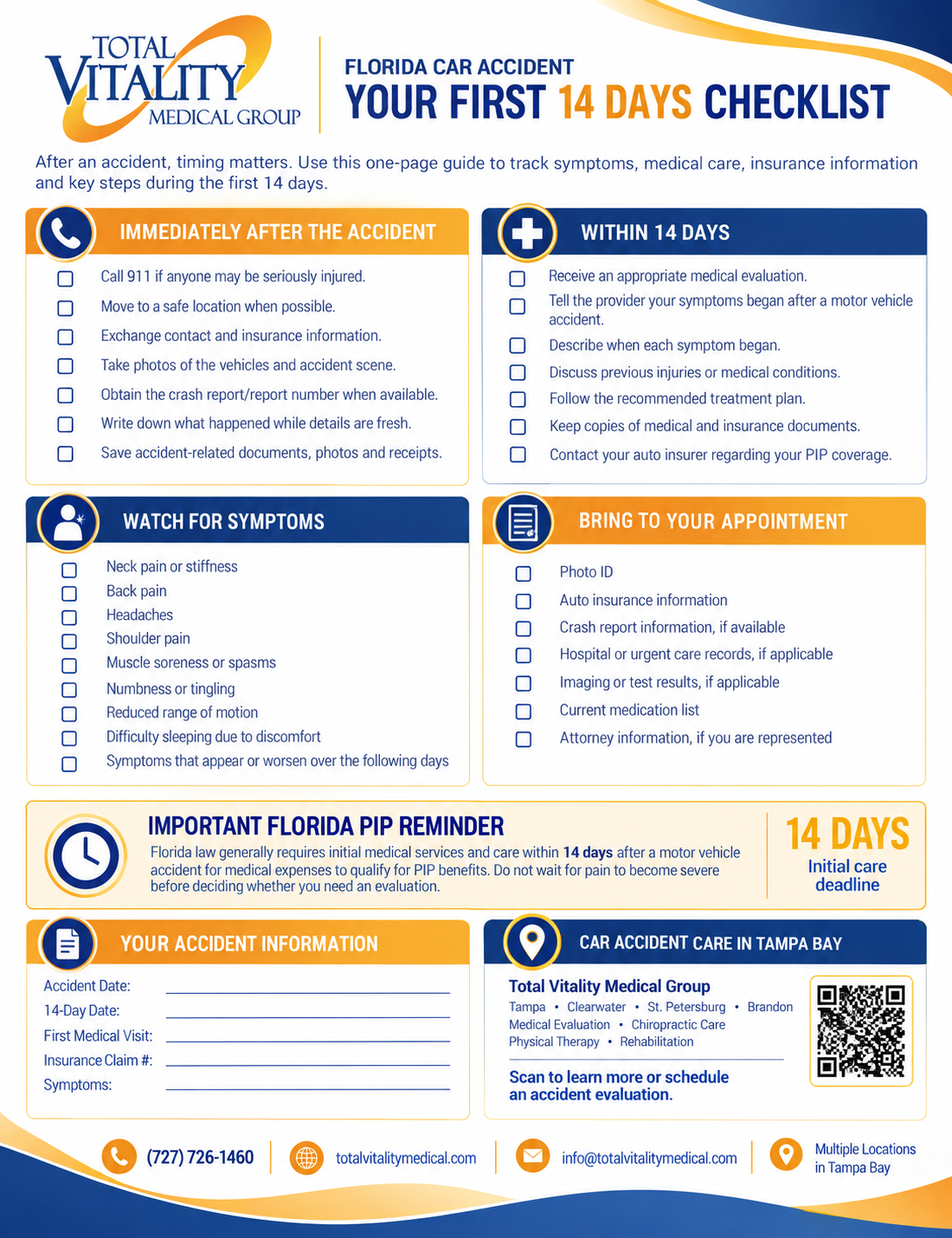
Florida Car Accident: First 14 Days Checklist
Been in an accident? Keep track of symptoms, medical care, insurance information and important steps during the first 14 days.
[Download the Free Checklist →]
However, the 14-day deadline may affect whether medical expenses qualify for payment under Florida PIP coverage.
Insurance coverage and accident claims can depend on the specific circumstances involved, so questions regarding your individual insurance benefits or legal rights should be directed to your insurance carrier or a qualified Florida attorney.
From a medical standpoint, persistent or worsening symptoms should still be appropriately evaluated.
Common Injuries After Florida Car Accidents
Car crashes can produce a wide range of injuries depending on the direction and severity of the impact, vehicle position, and other factors.
Some commonly evaluated accident-related conditions include:
Whiplash and Neck Injuries
Rapid movement of the head and neck during a collision can injure muscles, ligaments, and other structures in the cervical spine.
Symptoms can include neck pain, stiffness, headaches, and limited range of motion.
Back Pain
Car accidents may aggravate existing back problems or contribute to new injuries involving muscles, joints, discs, or other structures.
Herniated or Injured Discs
The forces generated during a collision can sometimes affect spinal discs. Depending on the location and severity of the injury, symptoms may include localized pain, radiating pain, numbness, or weakness.
Shoulder and Extremity Injuries
Seat belts, steering-wheel contact, bracing during impact, and sudden body movement can contribute to shoulder, arm, hip, or knee injuries.
Headaches
Headaches following a car accident can have several potential causes.
Because headaches can sometimes accompany more serious injuries, new, severe, or worsening headaches after an accident should not be ignored.
Car Accident Treatment in Tampa Bay
If you’ve recently been involved in a car accident in the Tampa Bay area, Total Vitality Medical Group provides evaluation and treatment for accident-related injuries.
With locations serving Tampa, Clearwater, St. Petersburg, and Brandon, our multidisciplinary team can evaluate your condition and recommend an individualized treatment plan based on your symptoms and clinical findings.
Our approach allows patients to access multiple types of care within one medical group, which may include medical evaluation, chiropractic care, physical therapy, and rehabilitation.
The goal is not simply to temporarily mask pain. It is to identify the source of your symptoms, help restore function, and support an appropriate recovery plan.
Frequently Asked Questions About Florida’s 14-Day PIP Rule
What is Florida’s 14-day PIP rule?
Florida law generally requires an injured person to receive initial services and care within 14 days after a motor vehicle accident for medical expenses to qualify for Personal Injury Protection benefits.
Do I have to go to the emergency room within 14 days after a Florida car accident?
Not necessarily. Florida law identifies specific providers and facilities that may provide qualifying initial services and care. However, serious or potentially life-threatening injuries should be evaluated in an appropriate emergency setting.
How much does Florida PIP cover after a car accident?
Florida law provides for reimbursement of covered services up to $10,000 when an authorized provider determines that the injured person had an emergency medical condition. When the injured person is determined not to have an emergency medical condition, reimbursement for covered services is generally limited to $2,500, subject to policy terms and applicable law.
What happens if I wait more than 14 days to see a doctor after a car accident in Florida?
Waiting more than 14 days to receive initial services and care may affect eligibility for medical benefits under Florida PIP. You may still seek medical care for your injuries, but you should contact your insurer regarding coverage and consult a qualified attorney regarding legal questions.
Should I see a doctor if I don’t have pain immediately after a car accident?
Some accident-related symptoms can appear hours or days after a collision. If you develop pain, stiffness, headaches, numbness, reduced mobility, or other symptoms after an accident, consider seeking an appropriate medical evaluation.
Don’t Ignore Florida’s 14-Day PIP Deadline
After a car accident, dealing with vehicle damage, insurance calls, and everyday responsibilities can make medical care easy to postpone.
But Florida’s PIP law makes timing important.
If you have been injured or are beginning to experience pain after a motor vehicle accident, consider getting evaluated as soon as reasonably possible.
If your accident occurred within the last 14 days, contact Total Vitality Medical Group to schedule a car accident injury evaluation at one of our Tampa Bay locations.
Important Notice
This article is provided for general educational purposes and is not legal advice or a guarantee of insurance coverage or benefits. Florida insurance laws and individual policies can change or vary. Contact your automobile insurer regarding your specific PIP coverage and consult a qualified attorney regarding legal questions. If you are experiencing a medical emergency, call 911 or seek emergency medical care.
About the Author: Dr. Adam Rosoff, DC

